
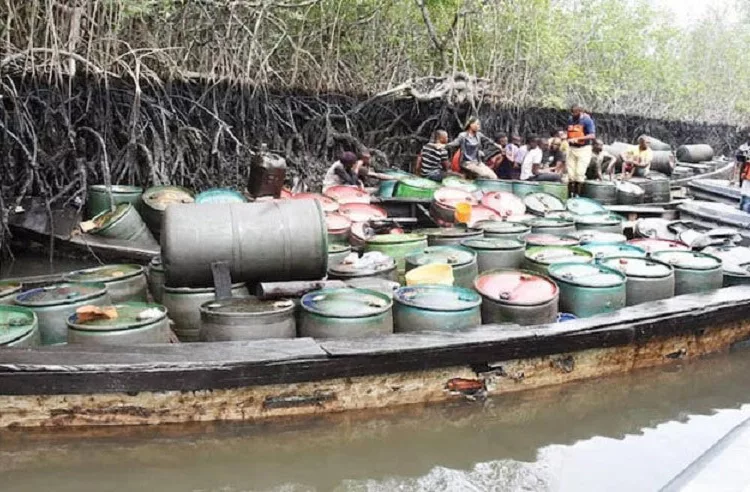
Nigeria’s oil theft crisis is expanding at an exponential rate, with new findings indicating that criminal networks are spreading beyond traditional creek hideouts into inland communities and commercial centres.
Security data and recent field operations show that oil theft syndicates are becoming more organised, decentralised and embedded within civilian environments. Storage hubs, artisanal refineries and distribution points are increasingly located in markets, warehouses and residential compounds areas that allow illegal operations to blend with legitimate economic activity.
ENigeria Newspaper investigation into the January 24, 2026 discovery of a large illegal crude storage and refining hub within Owaza Mami Market in Abia State underscores the trend. Investigators uncovered warehouses containing crude oil and refined products, alongside improvised refining equipment operating within a busy commercial corridor linked to the Trans-Niger Pipeline.
However, some energy analysts and stakeholders argue that the continued expansion of oil theft raises questions about the overall effectiveness of these surveillance frameworks. They note that despite increased funding and expanded mandates, illegal tapping, inland storage networks and distribution routes continue to surface.
Critics contend that while surveillance contractors have recorded interceptions and pipeline recoveries in some corridors, the persistence (and apparent growth) of organised theft networks suggests gaps in monitoring, intelligence coordination or enforcement follow-through.
Security sources, however, maintain that the terrain remains complex and that oil theft syndicates have adapted rapidly, shifting locations and methods to evade detection. They argue that the fight against crude theft requires not only surveillance patrols but also financial tracking, community engagement, stronger prosecutions and systemic reforms.
The development has also reignited scrutiny of pipeline surveillance arrangements in the Niger Delta. Government-backed surveillance contracts awarded to private security firms, including those linked to former militant leader Government Ekpemupolo, popularly known as Tompolo and his Tantina Security Services oufit, that is designed to curb vandalism and crude theft across critical pipeline infrastructure.
Nigeria is estimated to lose billions of dollars annually to oil theft, with ripple effects on foreign exchange earnings, public revenue and investor confidence. Environmental damage from illegal refining operations further compounds the economic toll.
Analysts warn that unless surveillance contracts are strengthened with measurable accountability standards, technological upgrades and transparent performance benchmarks, the exponential rise in oil theft may continue despite ongoing security efforts.
As operations migrate from creeks to communities, experts say Nigeria’s oil theft challenge has evolved into a more complex national security and economic issue that demands coordinated oversight beyond patrol boats and pipeline guards.