
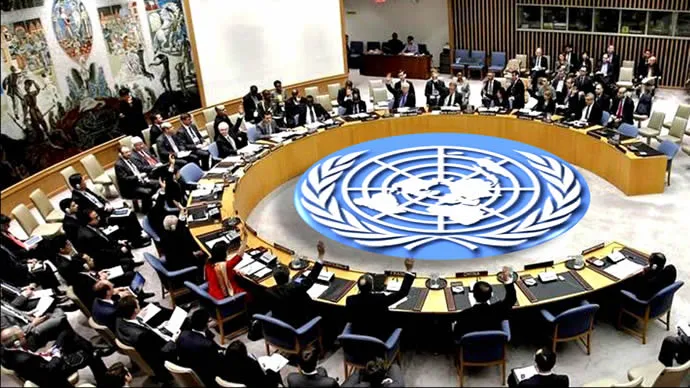
The United Nations Security Council is scheduled to vote Friday on a Bahrein‑drafted resolution that would allow countries to use “all defensive means necessary” to secure the Strait of Hormuz, a vital global shipping route disrupted by the ongoing Middle East conflict.
ENigeria Newspaper learnt that the draft resolution reportedly removes language permitting offensive military action after objections from permanent council members including China and Russia, who opposed any authorization that could escalate the conflict further.
Roughly one‑fifth of the world’s oil typically passes through the strait, a choke point that Iran’s blockade has largely stalled amid the war involving Iran, the United States and Israel, contributing to surging energy prices and economic instability.
Diplomats meet; vote delayed by holiday
Concern about the effects of the blockade is growing internationally, as seen by the participation of over 40 nations in a recent virtual diplomatic gathering to propose reopening the vital waterway.
However, because Good Friday is a United Nations holiday, the vote, which was initially scheduled for Friday, has to be rescheduled. A new date has not yet been announced.
Conflict enters 34th day with strikes continuing
With ongoing military exchanges around the region, the conflict entered its 34th day. Iran has reportedly replied to recent U.S. strikes on a significant bridge in Iran with its own airstrikes on economic and military targets, expanding the scope of hostilities.
One of the main points of contention is the continuous blockade of the Strait of Hormuz. Throughout the crisis, Tehran’s forces have maintained an effective chokehold on the canal, straining markets and driving up global petroleum costs.
US President Donald Trump recently posted a video of an attack on a bridge in Karaj, Iran, on social media. According to local authorities, the strike claimed eight lives.
The bridge that is currently under construction “comes tumbling down,” according to Trump, who also cautions Iran to “make a deal” before “nothing left.”
Meanwhile, following what appears to be an airstrike, footage from a missile facility close to the Iranian city of Isfahan shows significant explosions. Donald Trump declared on Wednesday night that the US would strike Iran “extremely hard” in the upcoming weeks and that its goals would soon be achieved.
Iran responds by saying that US-Israeli strikes have been “insignificant” and threatening “broader” and “crushing” reprisal.
Economic impacts and international pressures
Uncertainty over the strait’s status and the absence of a clear plan from international powers to reopen it caused oil prices to soar. Airline operations have also been impacted by market pressures, with ticket prices increasing as the cost of jet fuel rises.
Global diplomatic efforts are still ongoing, with a number of countries investigating military or economic approaches to reopen the strait while attempting to prevent a wider escalation.
How it started
On February 28, 2026, the United States and Israel launched Operation Epic Fury, a huge surprise air campaign that targeted Iran’s military leadership and infrastructure. The attacks killed senior officials and prompted swift retribution. This marked the beginning of the current US-Iran war. Iran quickly transformed the fight into a regional catastrophe by launching waves of missiles and drones across the Middle East, striking US sites, allies, and vital oil routes.
After more than a month, the conflict has intensified into protracted back-and-forth attacks, with the US continuing to target Iranian infrastructure while Iran shows that it still possesses substantial military power and the capacity to interrupt the world’s oil supply through the Strait of Hormuz.
What comes next?
The anticipated decision in the Security Council is viewed as a test of global determination to safeguard a vital maritime route without escalating hostilities. At least nine council members would need to endorse the proposal, and none of the five permanent members could veto it.
Global attention is still focused on whether concerted diplomatic or defensive measures can mitigate one of the most significant interruptions to international economic and energy flows in recent years, as fighting intensifies and Tehran signals continued opposition.