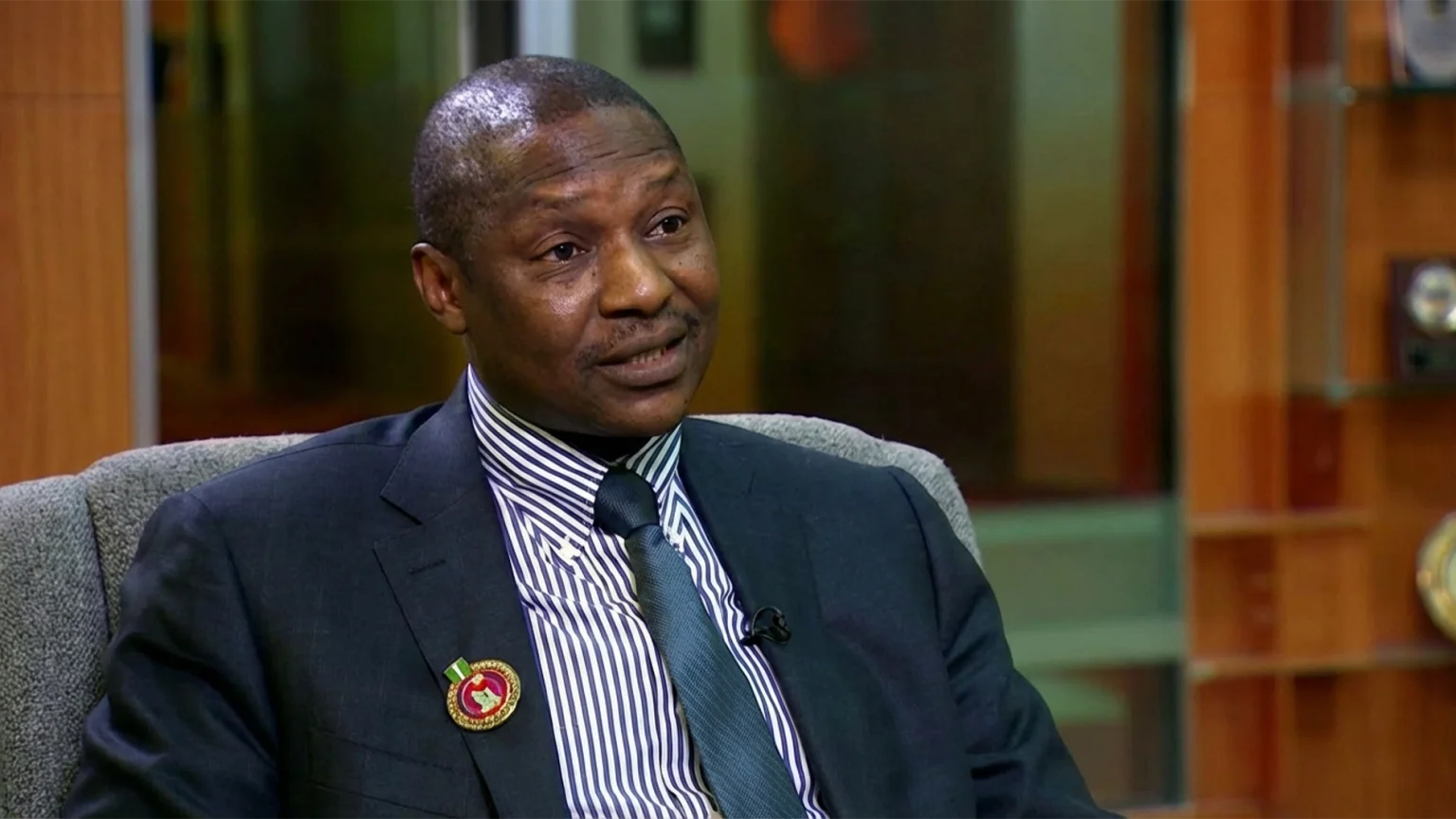
The Economic and Financial Crimes Commission (EFCC) has asked the Federal High Court in Abuja to permanently forfeit 57 properties allegedly connected to former Attorney-General of the Federation and Minister of Justice, Abubakar Malami, SAN, to the federal government, ENigeria Newspaper has gathered.
The anti-graft agency filed a motion for final forfeiture through its legal team, led by Jibrin Okutepa and Ekele Iheanacho, SAN. During proceedings before Justice Joyce Abdulmalik, the EFCC argued that the respondents had failed to present sufficient evidence to vacate an earlier interim forfeiture order for the properties.
Okutepa said, “This honourable court made an interim order forfeiting the properties to the Federal Government of Nigeria. The order of the honourable court has been published in a national daily, namely THISDAY Newspaper of 9th January, 2026. No sufficient cause has been shown why the properties under the interim forfeiture order should not be finally forfeited to the Federal Government of Nigeria.”
ENigeria Newspaper also gathered that the respondents in the suit, marked FHC/ABJ/CS/20/2026, include Malami, his son Abdulaziz Abubakar, wife Hajia Bashir Asabe, and Abiru’ Rahman Abubakar Malami as the first four respondents. Other respondents listed range from Rayhaan Bustan and Agro Allied Ltd to Real Edge Agro Services Ltd.
According to the EFCC, the application is founded on Section 17 of the Advance Fee Fraud and Other Fraud-Related Offences Act, No. 14 of 2006, which gives the court the authority to forfeit assets without a conviction.
The committee referenced several petitions in supporting affidavits that accused Malami of fraud, corruption, and abuse of office. This led to investigations that included looking through financial data from commercial banks and the Central Bank of Nigeria.
Deponent Daniel Adebayo, an EFCC investigating officer, outlined Malami’s known sources of income from his tenure between 2015 and 2023.
“Mr. Abubakar Malami, SAN, was the Hon. Minister of Justice and Attorney General of the Federation, hereinafter referred to as HAGF, from 2015 to 2023. He was paid a total of N89,664,000.00 as salary between 2015 and 2023, whilst in office, with an average payment of N962,663.68 per month. He also received a severance allowance of N12,158,400.00 at the end of his tenure in office.
“Mr. Malami SAN was also paid estacodes allowances to cover his travel expenses whenever he travelled outside the country on official trips. He calculated and declared a total sum of N253,608,500.00 as the amount he received for the official trips between 2015 and 2023 in a letter written to the Chairman of the CCB as an addendum to his Assets Declaration Form in June 2023.
“Attached and collectively marked as Exhibit EFCC 2 & 3 are copies of the asset declaration forms filled out by Mr. Malami SAN from 2015 to 2023, together with a letter dated June 16, 2023 written by him to the Chairman of the CCB as addendum to the assets declaration form as found at his house during EFCC’s execution of search warrant.”
Adebayo further alleged that many of the properties, especially in Kano and Kebbi States, were acquired without proper building permits and approvals.
“Aside the actual acquisition of the properties which are manifestly disproportionate to Mr. Malami‘s known and lawful sources of income, no building permits/approvals from appropriate authorities were obtained to erect most of the various structures in Kano and Kebbi States as part of a scheme to disguise unlawful origin of the funds used to acquire the assets.”
Malami was also charged by the EFCC with indirectly obtaining some of the assets through front companies or other third parties, including organizations he chaired inside the Rayhaan Group Ltd. The 57 properties, which include the temporary and permanent locations of Rayhaan University in Kebbi, are located in the states of Abuja, Kebbi, Kano, and Kaduna.
The hearing of the commission’s motion has been scheduled on April 21 by Justice Abdulmalik. Following an ex-parte request by the EFCC, Justice Emeka Nwite issued the interim forfeiture order on January 6. It was then transferred to Justice Obiora Egwuatu, who later recused himself, and then to Abdulmalik.
Malami and other respondents have challenged the civil suit, requesting the court vacate the interim order.
The EFCC argued that the permanent forfeiture is legally justified.
Okutepa told the court, “No sufficient cause has been shown why the properties under the interim forfeiture order should not be finally forfeited to the Federal Government of Nigeria.”
In order to give interested parties 14 days to present arguments against the assets’ permanent forfeiture, the court ordered the EFCC to publish the ruling in a national newspaper and ruled that the assets be temporarily forfeited to the Federal Government.
Malami and other respondents contested the forfeiture process after the interim ruling and asked the court to overturn it.