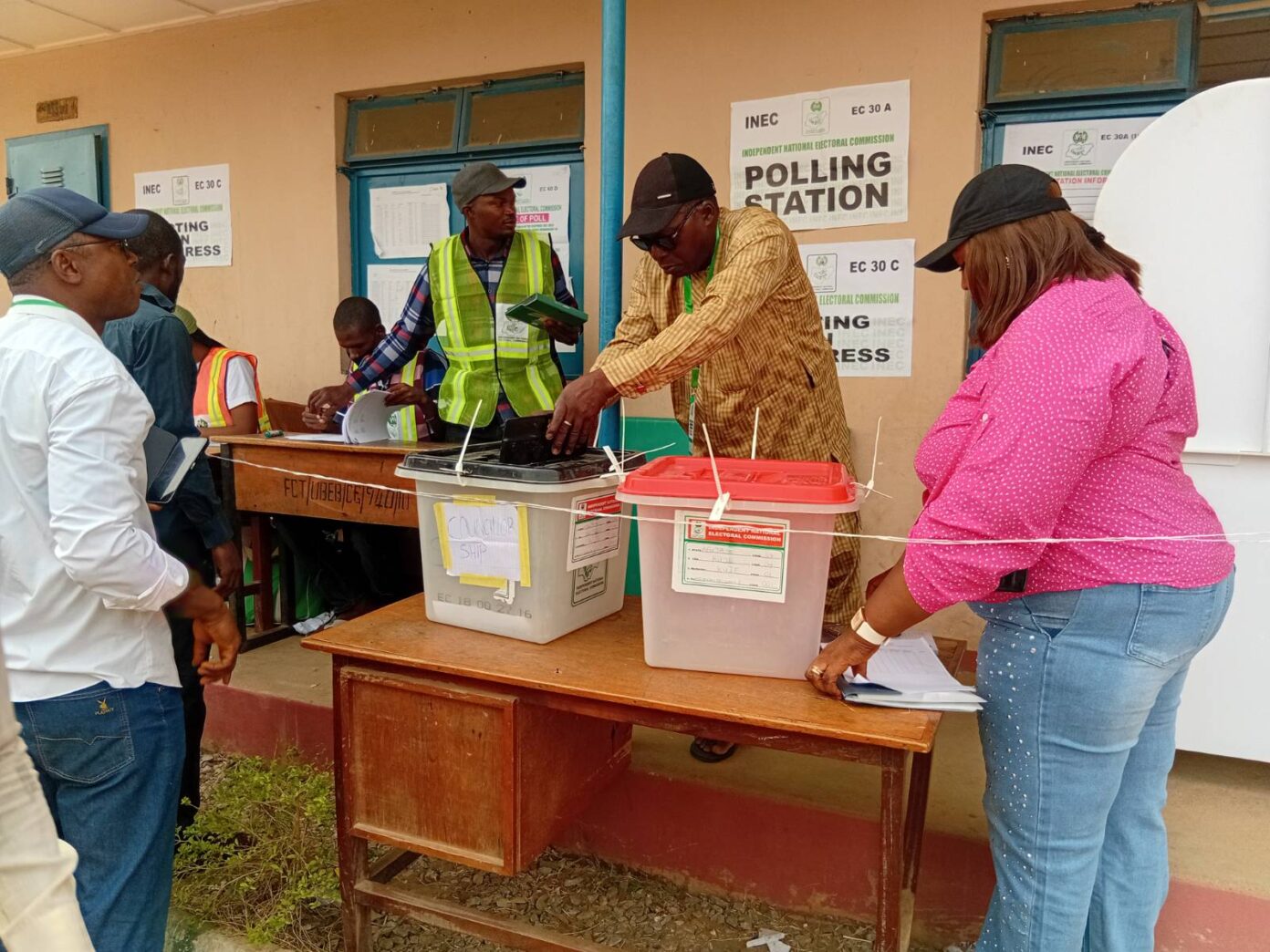
The just-concluded Area Council elections in the Federal Capital Territory (FCT) delivered a paradox: calm streets, orderly voting, and no reports of widespread violence — yet beneath the surface, clear signs of political division, institutional tension, and troubling voter apathy.
At Polling Unit 130, located at Gate 8 of the Presidential Villa in Abuja’s City Centre Ward, it was a revealing story. The ruling All Progressives Congress (APC) and the opposition African Democratic Congress (ADC) finished in a dead heat — seven votes each.
Even more revealing was the turnout: out of 784 registered voters, only 14 were accredited to vote.
It was democracy in its most fragile form. It was peaceful one but which people barely participated in.
Calm on the surface, tension beneath
The elections were conducted without major violence, a development welcomed by the FCT Minister, Nyesom Wike, who monitored the exercise across parts of Abuja. He defended the election-eve movement restrictions, clarifying that the curfew directive had presidential approval and was not a unilateral decision.
“We thank God that everywhere is peaceful,” the minister said, emphasizing that the absence of instability marked the primary success of the exercise.
However, the African Democratic Congress (ADC) painted a different picture. The party accused the minister of interfering in the electoral process, describing his presence at polling units as inappropriate given his political affiliation and cabinet position. It also alleged voter suppression and intimidation in parts of the territory.
Further heightening concerns were reports of disruptions to the Independent National Electoral Commission’s Result Viewing Portal (IReV) during collation — a development the ADC described as suspicious and deserving of public explanation.
The Independent National Electoral Commission (INEC) has yet to issue a detailed clarification on the reported portal disruption.
The participation problem
Perhaps the most sobering takeaway from the polls is not the partisan contest but the participation gap. The image of just 14 voters in a particular location determining the outcome at a polling unit with 784 registered voters speaks volumes about civic disengagement in parts of the capital.
Low turnout in off-cycle council elections is not new. But when it occurs at the heart of Nigeria’s administrative power, it raises deeper questions: Are urban residents increasingly detached from local governance? Has political fatigue set in? Or do council elections simply fail to inspire urgency among city dwellers?
Democracy requires more than peace; it requires participation.
Outsiders’ observations
A civil society organisation, Yiaga Africa, has raised concerns over vote buying, operational shortcomings and low voter turnout in its preliminary assessment of the FCT polls.
Although the elections were generally peaceful and voters who turned out were able to cast their ballots without widespread disruption, Yiaga Africa said participation levels were poor in many polling units visited by its observers.
The organisation reported that delays in the deployment of personnel and election materials disrupted the early stages of voting in several areas, especially within the Abuja Municipal Area Council. In some locations, preparations were still underway well into the morning, resulting in late commencement of accreditation and voting.
It also pointed to administrative issues that may have hindered voter access. According to the group, some polling units were moved to new locations without sufficient advance notice. While the Independent National Electoral Commission sent text message notifications to affected voters, many reportedly received the messages on election day, leading to confusion and prolonged efforts by voters to locate their assigned polling units.
Yiaga Africa further highlighted inconsistencies in the distribution of voters across polling units, describing the disparities as a potential indication of weaknesses in the commission’s polling unit expansion and redistribution plan.
In certain polling units, essential materials were either delayed or initially unavailable. The group cited instances where voter registers were not immediately accessible and others where basic voting infrastructure, including cubicles and ink pads, was missing.
The observers also reported that a strong security presence in some areas restricted the movement of accredited monitors and created obstacles for voters attempting to access polling centres.
Most significantly, Yiaga Africa documented incidents of vote buying at multiple polling units. It described the continued occurrence of monetary inducement as troubling, particularly in light of earlier assurances from the electoral commission that security agencies had been directed to clamp down on such practices.
The electoral body has yet to respond in detail to the concerns outlined in the preliminary report.
While the elections were conducted without major violence, Yiaga Africa’s findings suggest that procedural gaps and electoral misconduct remain persistent challenges in the FCT’s local government polls.
The larger picture
As Nigeria looks ahead to the 2027 general elections, the FCT exercise may serve as an early indicator of what lies ahead.
These issues raised are likely to intensify scrutiny of both electoral management and political conduct in the nation’s capital.