
With eyes already fixed on 2027, Federal Capital Territory politics witnessed a dramatic twist on Wednesday as the Peoples Democratic Party (PDP) chairmanship candidate for Bwari Area Council, Julius Adamu, withdrew from the race — throwing his support behind the All Progressives Congress (APC) candidate, Joshua Ishaku Musa.
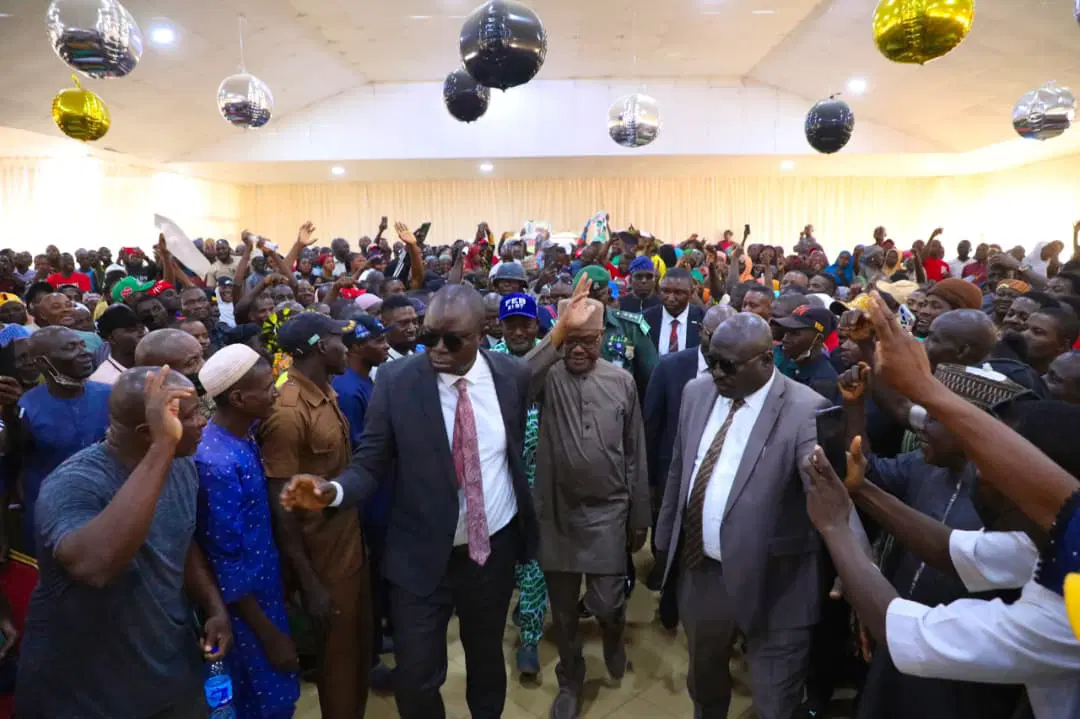
The move followed the direct intervention of FCT Minister, Nyesom Wike, who convened a high-level stakeholders’ meeting in Bwari less than 72 hours before the Area Council elections.
Adamu announced his withdrawal at the meeting, describing his decision as the outcome of consultations with the minister. He framed the development as a sacrifice for unity, stressing his personal relationship with the APC candidate.
“I have been in deep consultation with the FCT Minister,” he said.
“I have come to the conclusion that I and Joshua, we are brothers. It will not be nice for two brothers to kill themselves over one office. Therefore, I have relinquished my support to Hon. Joshua”, he added.
A calculated realignment
The withdrawal significantly reshapes the Bwari race ahead of the February 21 polls, narrowing the field and strengthening the APC’s position in what had been considered a competitive contest.
Observers say the development reflects Wike’s growing influence over political alignments in the territory, including within his own party, the PDP.
Addressing supporters, the minister openly campaigned for the APC candidate, promising accelerated infrastructure projects if Joshua wins.
“The people of Bwari, let me tell you why you should support Joshua. If you vote for Joshua, I will do more roads in Bwari. Let nobody make any mistake; on Saturday, come out and make sure that Joshua wins the election”, the FCT minister said.
The endorsement highlights a broader political recalibration in the FCT, where Wike has increasingly brokered cross-party alliances despite remaining a PDP member.
2027 calculations begin early
Beyond the immediate council election, political analysts interpret the episode as part of early positioning ahead of the 2027 general elections.
Wike, a former Rivers State governor and influential PDP powerbroker, has continued to assert himself as a central figure in the party’s internal dynamics. His strategic support for APC candidates in the FCT has reinforced perceptions that he is consolidating political control — both territorially and within the opposition party structure.
Control of PDP structures
Within the PDP, Wike’s actions are widely seen as part of a broader effort to dominate party structures and decision-making processes. Since the 2023 general elections, he has maintained a bloc of loyalists across states and has consistently demonstrated his ability to influence outcomes, whether through negotiations or strategic withdrawals.
The Bwari development underscores that influence. By persuading a PDP candidate to step down in favour of an APC aspirant, Wike signals that loyalty to his political strategy may outweigh strict party lines.
Critics within the PDP argue that such moves weaken party cohesion and blur ideological boundaries, while supporters insist that pragmatic alliances are necessary to retain relevance and bargaining power ahead of 2027.
A defining strategy in the FCT
The latest alliance also reinforces Wike’s governing style in the Federal Capital Territory, one built on centralized coordination and direct political leverage.
Since assuming office, he has positioned himself not just as an administrator but as the dominant political force shaping the FCT’s electoral landscape.
As preparations conclude under the supervision of the Independent National Electoral Commission (INEC) for elections across the six Area Councils — Abuja Municipal (AMAC), Bwari, Gwagwalada, Kuje, Abaji, and Kwali — the Bwari realignment stands out as the most consequential last-minute shift.
Whether the strategy strengthens Wike’s grip on the PDP ahead of 2027 or deepens internal fault lines remains to be seen.