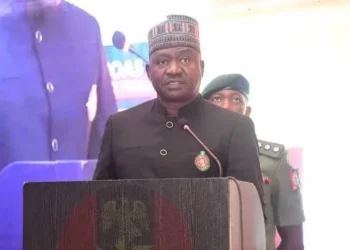
Human Rights Attorney Femi Falana has urged the Lagos State Government to transform Makoko into sustainable “water cities” instead than moving residents to far-off places, ENigeria Newspaper has learnt.
Speaking on Tuesday at a news conference hosted by the Coalition Against Demolitions, Forced Evictions, Land Grabbing and Displacements, Falana stated that the Lagos government, in collaboration with UN organizations, has to begin developing water cities in the waterfront neighborhoods.
“The Lagos government in partnership with UN agencies must start the development of water cities in the waterfront communities”, he said.
Falana urged the government to follow suit and make sure that development benefited the “poor masses,” citing a 2006 World Bank project that upgraded nine Lagos slums, including Makoko. He went on to say that locals desire to live in their neighborhoods with dignity and urged strong community involvement in the creation of rehabilitation plans.
He also emphasised that residents rejected the relocation plan recently proposed by the Lagos State House of Assembly to move communities in Makoko, Oko-Agbon, and Sogunro to Agbowa in Epe.
“Lagos has no court order to take people from Makoko to Agbowa. People affected must be carried along. The proposal was rejected by the waterfront communities and their allies across the country. Develop where we are. Our people want to live a life of dignity,” Falana said.
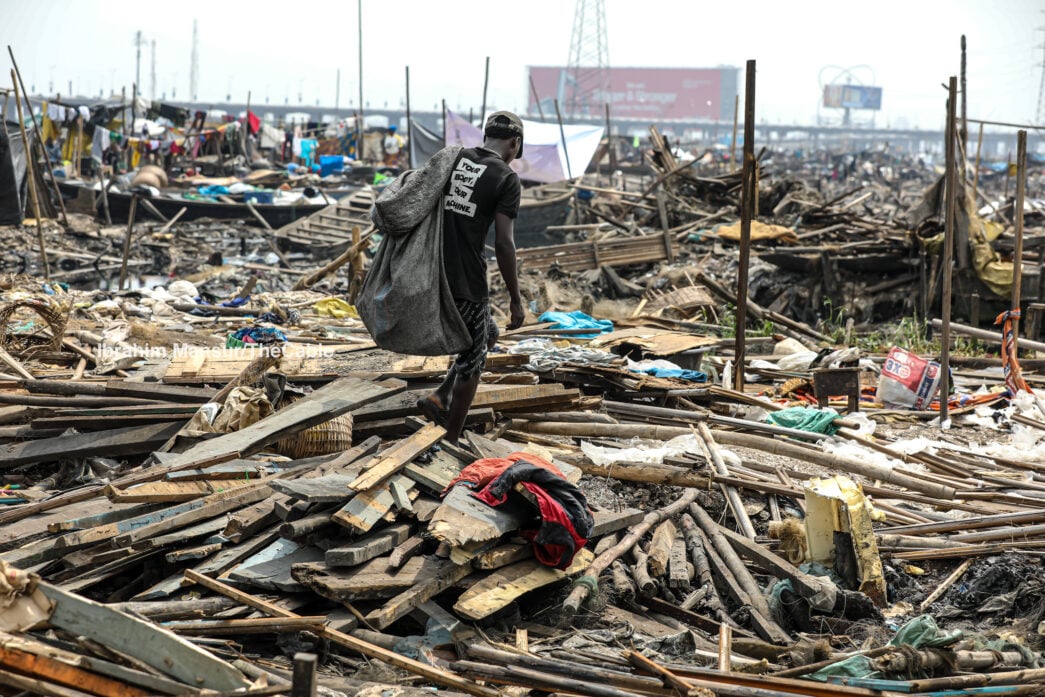
The call follows the December 2025 demolitions at the Third Mainland Bridge in Makoko, which forced many locals to relocate and provoked large-scale demonstrations. Communities in Owode Onirin, Oworonshoki, Otumara, and Baba-Ijora have also been impacted by similar operations.
Falana criticised the state government for allegedly displacing residents to make way for high-end real estate, saying, “We are here to say enough is enough! We are not going to allow any demolition of settlements again either in Lagos or any other parts of the country.”
He also highlighted the government’s failure to comply with court rulings in favour of the affected communities.
“No government has the power to render citizens homeless. If for any developmental purposes, the government decides to take over my property, alternatives must be provided or payment of compensation, that is fair and just,” Falana said.