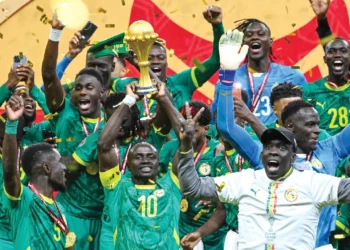
By Monday night, either DR Congo or Nigeria might be facing heartache or standing on the brink of history.
FIFA, the body that oversees world football, is expected to make a decision regarding Nigeria’s objection regarding player eligibility in the pivotal African playoff match in November 2025, in which DR Congo defeated the Super Eagles in a thrilling 4–3 penalty shootout.
The protest, lodged by the Nigeria Football Federation on December 15, 2025, alleges that six Congolese players had recently switched international allegiance and were not eligible to feature at the time of the match. These six players, include Aaron Wan Bissaka (West Ham), Mario Stroeykens (Andeletch), Mattheu Epolo (Standard Liege), Axel Tuanzebe (Ipswich Town), Arthur Musuaku (Besiktas), and Michel-Ange Balikwisha (Celtic).
If upheld, the ruling could overturn the result and propel Nigeria into the six-team Intercontinental Play-Off in Mexico this March — one final shot at a ticket to the 2026 World Cup in the United States, Canada and Mexico.
Eligibility disputes are not new. And when they arise, FIFA’s hammer can fall in several decisive ways.
But how might FIFA rule? History offers clues.
Nigeria itself, for instance, have felt FIFA’s disciplinary weight before. During qualification for the 2018 World Cup, the Super Eagles fielded Abdullahi Shehu despite an outstanding suspension for accumulated yellow cards. FIFA responded by awarding Algeria a 3–0 victory and imposing a fine. The ruling did not derail Nigeria’s campaign only because they had already secured qualification. The principle, however, was unmistakable: administrative oversights do not excuse ineligible appearances.
South Africa paid a far steeper price during the ongoing 2026 qualifying campaign. When it emerged that midfielder Teboho Mokoena had played despite serving a suspension for accumulated yellow cards, FIFA nullified Bafana Bafana’s 2–0 victory over Lesotho, converted it to a 3–0 defeat, and docked the team three points. The ruling significantly altered the group table and intensified the battle for qualification spots, though South Africa eventually finished top of the table to qualify for the World Cup.
In other instances, nationality documentation has proven decisive. Burkina Faso saw a World Cup qualifying result forfeited in 2012 when questions arose over Hervé Zengue’s eligibility paperwork. Gabon suffered a similar fate in 2014 after Charly Moussono was ruled ineligible due to previous representation of Cameroon in beach soccer. In both cases, the administrative details — not on-field performance — determined the outcome.
There have also been cases where suspension rules proved costly. Ethiopia, Togo and the Solomon Islands each had qualifying results overturned after fielding players who should have been side-lined due to accumulated cautions. In those situations, FIFA applied its regulations with consistency: the matches were forfeited, and the competitive damage was immediate.
Taken together, these precedents suggest that if FIFA determines DR Congo fielded players who were indeed ineligible under its nationality-switch regulations, the likely remedy would be forfeiture of the playoff result. However, if the players’ eligibility had been properly processed and approved, the outcome of the match will stand — regardless of the controversy surrounding it.
For Nigeria, the stakes are existential: a favourable ruling would reopen the road to the 2026 World Cup in the United States, Canada and Mexico. For DR Congo, it is about preserving a hard-earned triumph and avoiding a bureaucratic reversal of fortune.
When FIFA rules today, it will not merely settle a protest. It will only reaffirm how firmly football’s global rulebook governs the thin line between elimination and history.