
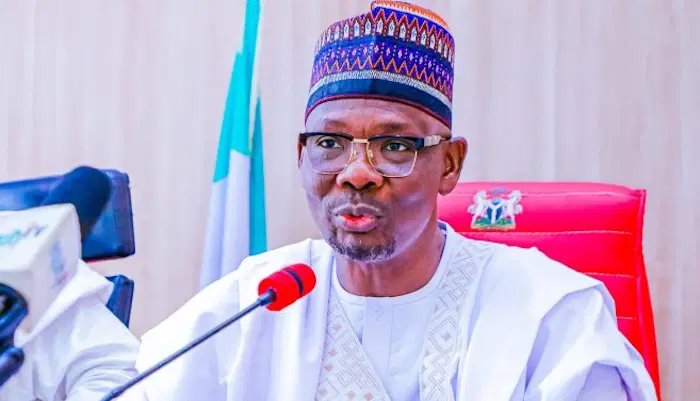
Nasarawa State Governor Abdullahi Sule has downplayed the rising profile of the African Democratic Congress (ADC), insisting that the ruling All Progressives Congress (APC) has no reason to feel threatened ahead of the 2027 general elections.
Speaking during an interview on Channels Television’s Politics Today on Monday night and monitored by ENigeria Newspaper, Sule dismissed suggestions that the ADC poses a serious challenge to the APC’s dominance, stressing the ruling party’s nationwide control and political strength.
He said: “At one point, they said the PDP is the strongest opposition to our party, so now it is the ADC. You’ll continue to hear this goalpost keep moving. There’s no problem whatsoever with our party.
“A party controlling 31 states cannot actually be scared of a party that doesn’t control one state”, he added, emphasising the APC’s position as things stand at the moment.
Sule’s remarks come amid growing conversations around the ADC’s emergence as a potential opposition platform, following increased political realignments and defections from across party lines in recent months.
Addressing insecurity — an issue frequently highlighted by opposition voices — the governor acknowledged the scale of the challenge but pointed to state policing as a viable long-term solution.
According to him, there is already strong consensus among state governments on the initiative.
“When we sat down at the NEC level to discuss, I think 35 out of 37 signed up for state policing. We agreed to go on with it,” he said.
He explained that while implementation may take time due to legislative processes, the commitment remains firm. “I think it is the parameter because it has to go into amending the law, it has to go to the National Assembly, it has to go to all the assemblies at various states. I think it is just the process that is taking time, but as far as we are concerned, I think every state believes strongly in state policing and Nasarawa is one of them.”
Despite Sule’s dismissal, the ADC has continued to position itself as a major opposition force ahead of 2027, attracting attention through high-profile defections and increasing political mobilisation across the country.