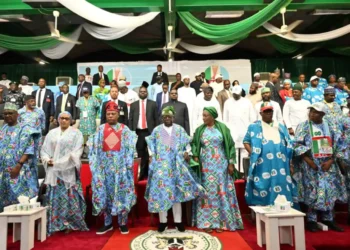
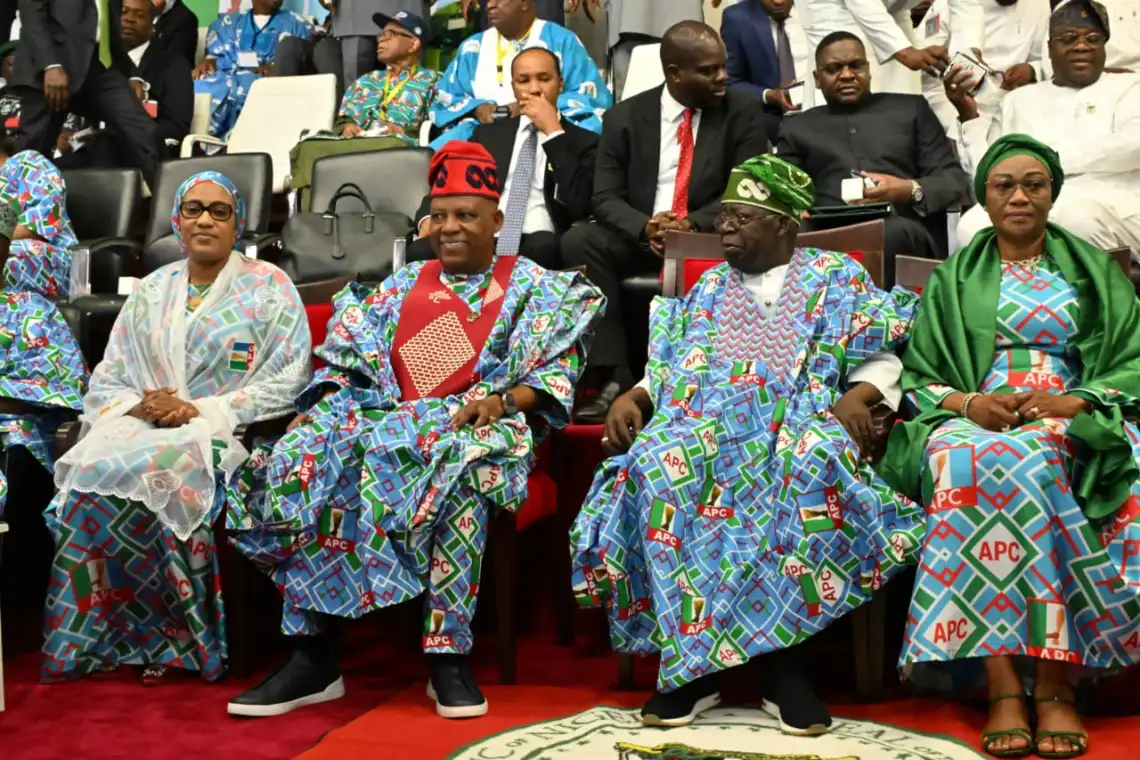
President Bola Ahmed Tinubu, on Friday at the All Progressives Congress (APC) 4th National Convention, said that Nigeria’s economy is gradually stabilising, with inflation declining to 14.45% after eight consecutive months of reduction.
Addressing party faithfuls at the Eagle Square, Tinubu said the government’s reforms under the Renewed Hope Agenda were already yielding tangible results despite challenging global conditions, including the ongoing US-Israeli-Iranian War.
“Inflation has declined steadily for eight consecutive months to 14.45%, while food prices are easing, bringing gradual relief to households. Business confidence is returning, with 12 consecutive months of economic activity expansion,” he said.
The President described his economic policies as necessary interventions to redirect the country toward sustainable growth. “No nation rises by hiding from the truth. No economy grows by sustaining wasteful subsidies or dysfunctional priorities. No future is built on perpetual self-denial,” he said, defending tough but necessary reforms, including fiscal policy adjustments and social investment programmes.
Tinubu highlighted a series of achievements, including a booming stock market, mega profits for listed companies, successive trade surpluses, and strengthened foreign exchange buffers to protect the economy from external shocks. He said investor confidence has vastly improved, with the oil and gas sector once again attractive to foreign investors. He also noted that Nigeria’s Eurobond issuance was oversubscribed by 400%, and the country successfully exited the FATF Grey List, marking a decisive return to global financial credibility.
The President further stressed that his administration has been prioritising long-term reforms over short-term popularity, acknowledging that some decisions were difficult but necessary for national prosperity.
“The sacrifices of today are laying the foundation for Nigeria’s prosperity tomorrow. Our leaders, party members, and supporters can take pride in the success we have achieved in redirecting our country,” he said.
He also addressed legacy challenges, particularly in electricity supply, citing plans to establish the Grid Asset Management Company (GAMCO), which is expected to inject approximately 1,600 megawatts into a new grid corridor. He reaffirmed ongoing infrastructure projects, including superhighways, concrete-and-steel roads, and the modernisation of seaports and airports, alongside fiscal and social investment reforms.
Tinubu also emphasized on his economic address by linking these reforms to national unity and growth.
He urged women and young people to participate actively in governance and decision-making, pointing out that their greatest national assets are their bravery, inventiveness, digital fluency, creativity, and enterprising spirit.