
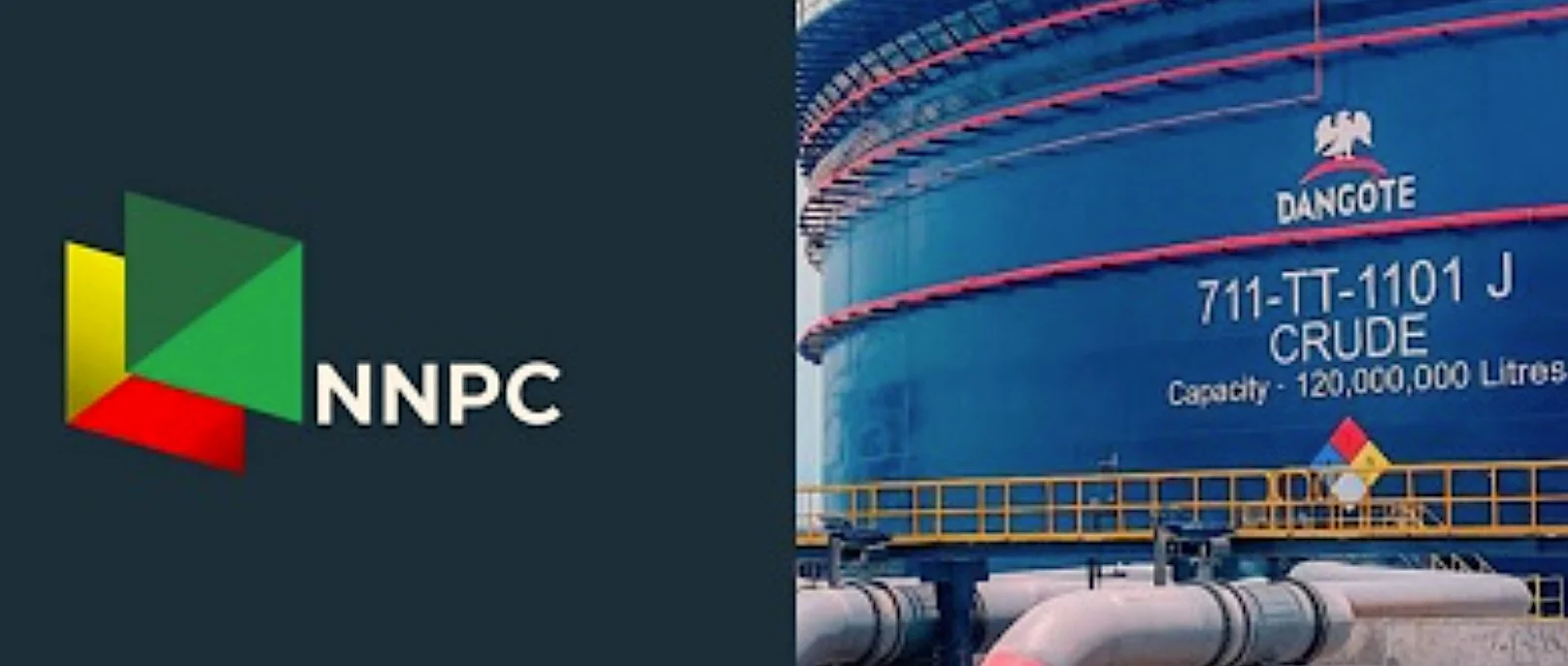
The Nigerian National Petroleum Company Limited (NNPC Ltd.) has started preparations to source crude oil from international traders to sustain operations at the Dangote Petroleum Refinery, highlighting the country’s heavy reliance on foreign oil despite its abundant local reserves.
Recall that Dangote temporarily suspended Premium Motor Spirit (PMS) loading twice last week, a development that pushed retail petrol prices to over N1,200 per litre in some states.
A senior NNPC official, speaking on condition of anonymity in a recent interview, said,
“Leveraging our global crude trading network, we are sourcing third-party crude for the refinery at prices that are competitive with prevailing international market rates.”
The official added that this is part of the company’s ongoing effort to ensure energy security and continuous supply.
Despite being Africa’s largest oil producer, Nigeria has seen US crude imports surge to 41.13 million barrels in 2025, up 161 percent from 15.79 million barrels in 2024, according to Kpler analytics. The Dangote refinery imported 590,000 barrels per day in July 2025, with 60 percent from US light sweet crude.
Experts argue that domestic allocations remain insufficient.
Another top professional of the field noted that the refinery’s heavy reliance on imported crude, coupled with limited domestic allocations, inevitably pushes costs onto consumers. He stressed that full access to government-provided cargoes under the naira-for-crude policy would help moderate these price pressures.
The ongoing Iran-US conflict has also disrupted global oil markets, pushing Brent crude prices above $92 per barrel. This is thus an obvious reason to conclude that cthe combined effect of geopolitical tensions, domestic allocation gaps, and high operational costs is exacerbating fuel price hikes locally.
To mitigate supply disruptions, Dangote has expanded its distribution network, approving over 30 marketers and partners nationwide, including NIPCO, MRS Oil, TotalEnergies, and Conoil. A refinery source noted that while international sourcing helps maintain output, it may not immediately reduce pump prices for consumers.
Another analyst suggested that keeping imported crude to a limited share while prioritizing local refining would help stabilize the market, boost economic resilience, and enhance national energy security.
With retail petrol now averaging between N1,030 and N1,100 per litre, the situation of the nation, though amidst an ongoing US-Iran-Gu;f war, Nigeria, despite its vast oil resources, continues to rely on foreign crude, leaving consumers to shoulder the burden of international market volatility.