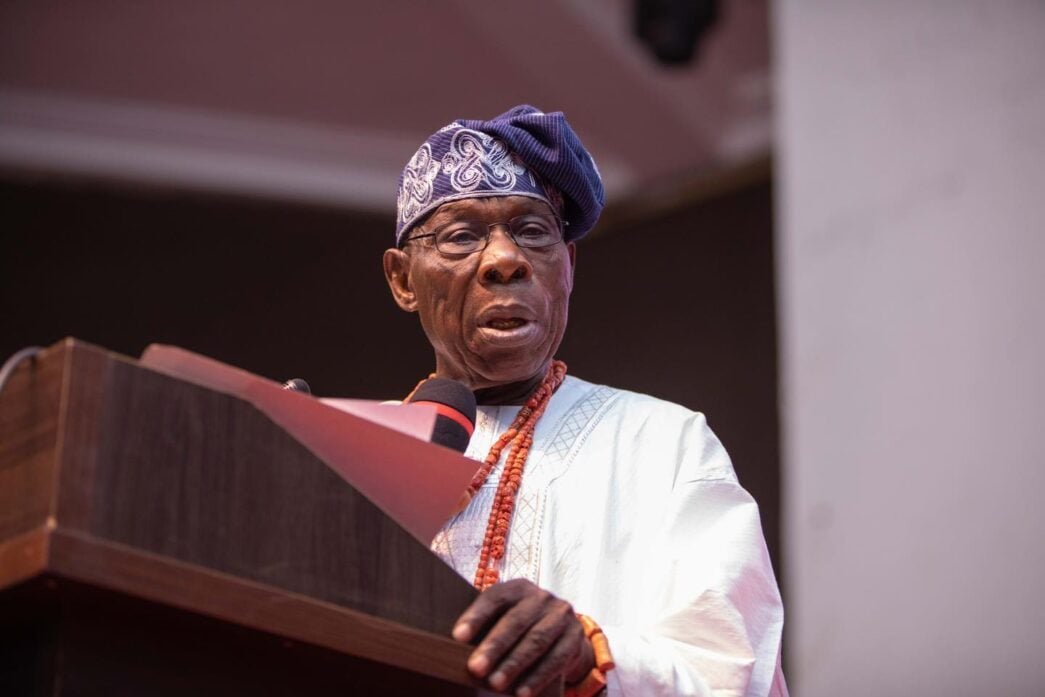
Former president of the Federal Republic of Nigeria, Olusegun Obasanjo, has revealed the reasons why Africa continues to live without peace. These reasons, which he called, ‘the greatest obtacles’ to a durable peace in Africa, are factors that are birthed by internal and external factors.
ENigeria Newspaper gathered this while Obasanjo spoke on Thursday during the third Mashariki cooperation conference, tagged “Emerging geopolitical dynamics and Africa’s security architecture.” tagged held in Diani, Kwale County, Kenya.
The former president reflected on his time as a military head of state and a civilian president years on, noting that without denying the legitimate grievances of citizens that led to support for military takeovers, these takeovers “without a credible political process are at best a pause in fighting and at worst a prolongation of it.”
He, however, warned that conflict resolution and governance crises are well managed by robust intelligent measures because if not managed properly, they descend into more chaos.
“In nearly every conflict I have helped to mediate, the warning signs were visible months or years before the first shot was fired.
“Ethnic tensions were being deliberately inflamed. Electoral processes were being manipulated. Youth were being recruited into militias. Economic marginalisation was deepening.
“Regional neighbours were beginning to take sides. The information existed. What was missing was the institutional will to act on it, to share it across borders and to take the political risks that early intervention requires”, he said.
“The intelligence community in Africa must become more explicitly and systematically focused on early warning and early action by regional leaders.
The former president urged that conflicting bodies should always seek the proper channel for resolutions, especially African’s foremost body responsible for resolving issues related to African nations.
“The continental early warning system of the African Union exists for precisely this purpose. It must be better resourced, better staffed and, above all, better connected to decision-makers who are prepared to act on what it tells them.
“The third conclusion is that the financing and arming of proxy forces by external actors is one of the greatest obstacles to durable peace in Africa, and that intelligence services have a particular responsibility to expose it.
“In the DRC, Rwandan and Ugandan support for armed groups was documented over the years by UN panel of experts reports.
“In Sudan, external actors provided material and political support to parties that had no incentive to reach a settlement as long as that support continued.
“In Libya, since the fall of Muammar Gaddafi in 2011, a bewildering array of external states, including the UAE, Turkey, Egypt, Russia and several European governments, have poured weapons and fighters into a conflict that they have simultaneously claimed to want to resolve. The hypocrisy is breathtaking.
“African intelligence services that can accurately map these external interventions and bring that mapping to the attention of the African Union and the UN security council perform a service not only to the countries directly concerned but to the entire project of African peace”, he concluded.