
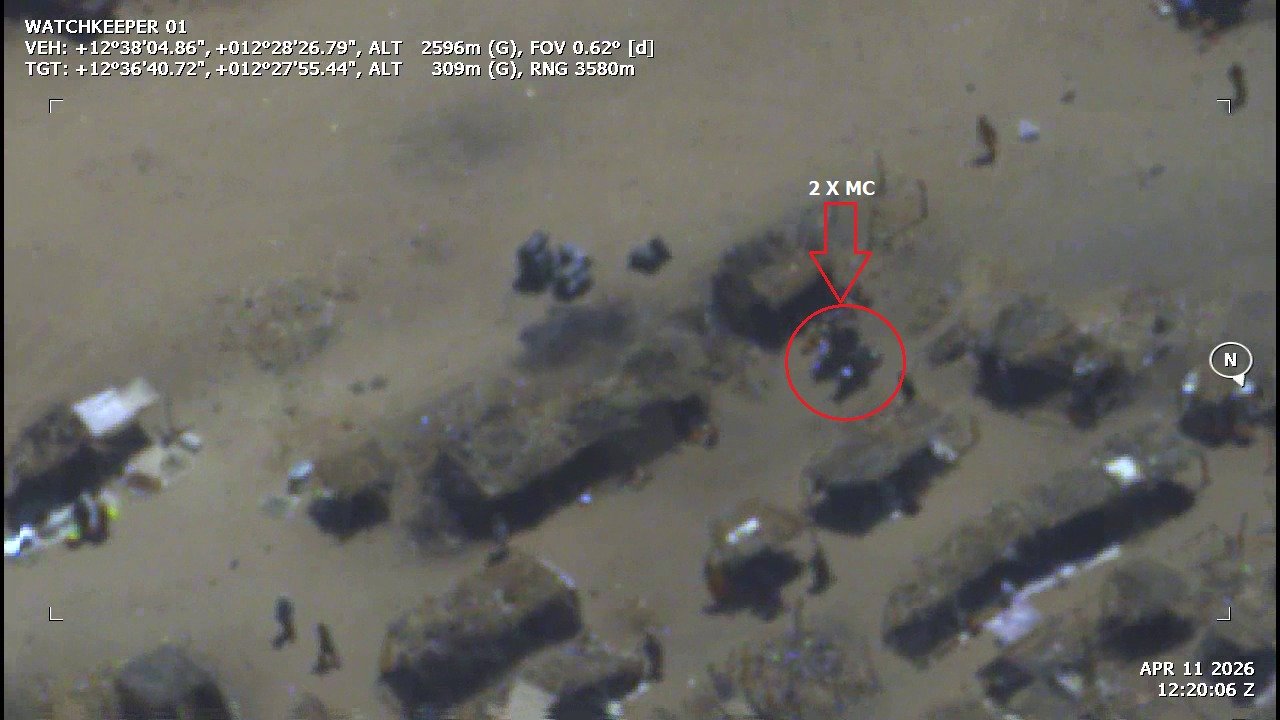
The Nigerian military has revealed why the airstrikes on the Jilli market which bordered the lines of Borno and Yobe states were not an ‘accidental’ bombing.
Reports have ENigeria Newspaper reported that over 40 civilians have died as a result of the hit, which was carried out on Saturday as part of Operation HADIN KAI. However, some reports suggested that the number of victims could be far higher, indicating the continued misunderstanding and lack of agreement regarding the precise number of casualties.
However, the military has defended the action, insisting that the market was indeed an enclave for terrorists who went there to discuss and trade terrorism logistics. It also said that the market was a convergence point for fighters of the Islamic State West Africa Province.
Lt. Col. Sanni Uba, the Media Information Officer of the Northeast Joint Task Force, Operation Hadin Kai, said in a statement on Sunday that the operation was the result of ongoing intelligence, surveillance, and reconnaissance missions that followed the movements of suspected terrorists, including motorcycles and gun trucks, as they gathered in the area.
“The Air Component of Joint Task Force (North East) Operation HADIN KAI, in a carefully, well-coordinated, planned, and intelligence-driven operation, has successfully conducted a precision air strike on a known terrorist enclave and logistics hub located near the abandoned village of Jilli in Gubio Local Government Area of Borno State.
“The successful strike, executed on 11 April, 2026, followed sustained intelligence, Surveillance and Reconnaissance (ISR) missions over the Bindul–Jilli axis, an area long identified as a major terrorist movement corridor and convergence point for Islamic State West Africa Province terrorists and their collaborators”, he said.
“It will be recalled that in January 2026, troops moving from Gubio towards Damasak came under a major Improvised Explosive Device attack along the road at Bindul, resulting in the tragic loss of eight soldiers, while several others were wounded in action. More recently, on 9 April, coordinated attacks were recorded in Ngamdu and Benisheik, supported by the same terrorist logistics network.’’
Sanni also emphasized the military received intelligence that some terrorists had plied that route some days ago on motorcycles and gun trucks.
“Consequently, ISR coverage over the area was immediately intensified. During the surveillance mission, a contingent of motorcycles was observed moving in the direction of Jilli, followed shortly by the movement of several additional vehicles, all converging on the same location. These suspicious movements were subsequently corroborated by credible human intelligence sources, confirming that the converging elements were terrorists, their collaborators, and logistics handlers,” he said.
“It is imperative to state that, in line with established operational procedures, a rigorous and professional targeting process was undertaken”, he added.
Borno State defends airstrikes
However, Gov. Zulum Babagana of Borno state has also defended the strikes, saying that the market has been closed down five years ago.
“I have been properly briefed on the airstrikes carried out by the Air Component of Operation Hadin Kai on Jilli market, a border town between Borno and Yobe states. Let me state categorically that the Borno State Government closed Jilli and Gazabure markets five years ago,” the governor said.
“I am in close consultation with the Government of Yobe State and the military hierarchy on the matter,” he added.