

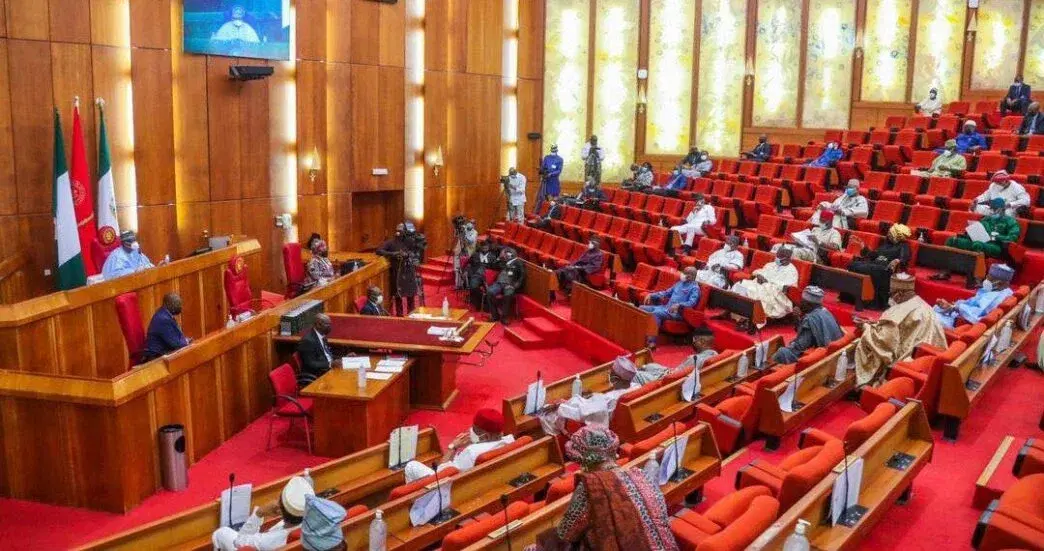
The Senate on Wednesday signalled a major shift in Nigeria’s financial regulatory landscape, opting for a coordinated oversight structure for digital finance rather than the creation of a standalone fintech regulator.
At a one-day public hearing on the Banks and Other Financial Institutions Act (Amendment) Bill 2025 (SB. 959), lawmakers resolved to strengthen the supervisory authority of the Central Bank of Nigeria (CBN) while institutionalising collaboration with other key regulatory and security agencies.
The hearing, jointly convened by the Senate Committees on Banking, Insurance and Other Financial Institutions; ICT and Cyber Security; Capital Market; and Anti-Corruption and Financial Crimes, also examined the proliferation of Ponzi schemes, including the recent collapse associated with Crypto Bullion Exchange (CBEX).
Chairman of the Senate Committee on Banking, Insurance and Other Financial Institutions, Senator Tokunbo Abiru, said the proposed amendment aims to close regulatory gaps created by the rapid expansion of technology-driven financial services. He noted that fintech firms, including digital lenders, mobile money operators, payment gateways and settlement platforms, now process massive transaction volumes and serve millions of Nigerians.
According to Abiru, the current framework for identifying Systemically Important Financial Institutions largely focuses on traditional banks and does not sufficiently capture large, data-driven non-bank platforms. He warned that this blind spot could pose risks to financial stability, consumer protection, data governance and national security.
Under the proposed changes, the CBN would be empowered to designate qualifying fintech and digital financial service providers as Systemically Important Institutions.
The bill also seeks to establish a national registry to enhance transparency and disclose beneficial ownership, alongside risk-based supervision tailored to technology-enabled operations.
Lawmakers firmly rejected suggestions to create a new fintech regulatory agency. Abiru argued that setting up another body would duplicate responsibilities, create bureaucratic overlap and fragment oversight in a sector that demands coherence and coordination.
Instead, the Senate is advocating a structured collaboration framework involving the CBN and agencies such as the Securities and Exchange Commission, Nigerian Communications Commission, National Information Technology Development Agency, Corporate Affairs Commission, Federal Competition and Consumer Protection Commission, the Office of the National Security Adviser and the Federal Ministry of Finance.
Representing Senate President Godswill Akpabio, Senate Leader Opeyemi Bamidele said the engagement reflects the legislature’s responsibility to safeguard the stability and credibility of Nigeria’s financial architecture. He described the financial system as the backbone of the economy and stressed that regulation should be viewed as the foundation for sustainable innovation rather than an obstacle to growth.
“Digital innovation must function within well-defined legal parameters that guarantee consumer protection, cybersecurity, operational resilience and transparency,” Bamidele said, emphasising the need to strengthen supervision of systemically important institutions, including fintech operators.
ENigeria Newspaper also learnt that senators expressed concern about the rise of fraudulent investment platforms and digital Ponzi schemes, describing them as a serious threat to investor confidence and economic stability. They said the investigative review would assess enforcement gaps, inter-agency coordination and whether current laws sufficiently address digital and cross-border financial crimes.
Agencies including the Nigeria Deposit Insurance Corporation, the Economic and Financial Crimes Commission, the Nigerian Communications Commission, the Federal Competition and Consumer Protection Commission, the Ministry of Finance Incorporated and the Chartered Institute of Bankers of Nigeria submitted memoranda at the hearing.
At the close of proceedings, the Senate reiterated its commitment to building a cohesive supervisory framework that allows fintech innovation to thrive under coordinated oversight anchored by the CBN, while protecting Nigerians from systemic risks and financial exploitation.