

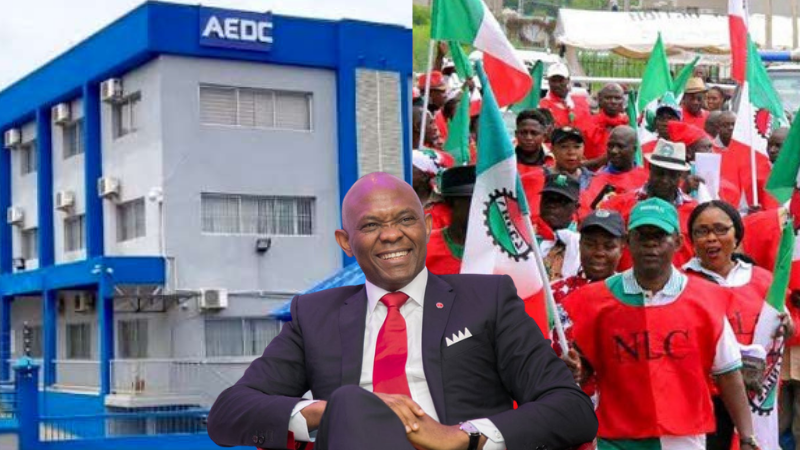
Nigeria’s capitalist, Tony Elumelu may come across as a businessman and philanthropist especially with his famed Tony Elumelu foundation, but a deeper look into the recent crisis rocking one of his business interests, “Abuja Electricity Distribution Company” (AEDC) suggest the opposite. ENigeria Newspaper takes a cursory look into the lies, controversies and why over 900 workers of AEDC in conjunction with the Nigerian Labour Congress (NLC) hours ago, picketed the Abuja headquarters of the power distribution company.
Brief Background of AEDC Acquisition by Tony Elumelu-Led Transcorp Plc.
To strengthen its foothold in the Nigerian power sector, Transcorp Plc, under the chairmanship of Tony Elumelu, acquired a 60% controlling stake in the Abuja Electricity Distribution Company (AEDC) in August 2023, one of Nigeria’s 11 electricity distribution companies (DisCos).
The acquisition followed a complex chain of financial and legal developments tied to an outstanding debt of approximately $122 million owed to United Bank for Africa UBA chaired by Tony Elumelu.
Back in 2013, KANN Consortium, the previous core investor in AEDC, had secured a 60% stake in the utility through a loan facility obtained from UBA. However, by 2021, the consortium had defaulted on its repayment obligations, triggering a high-stakes takeover process.
In December 2021, UBA exercised its rights as lender and seized the consortium’s equity stake, setting off a contentious and widely scrutinized transition. Following the takeover, the bank assumed interim control of the utility while initiating a process to divest the asset.
After months of evaluation, a consortium led by Transcorp emerged as the preferred bidder. The transaction received regulatory approval in May 2023, paving the way for the eventual transfer of the 60% stake. The acquisition was structured primarily to settle the outstanding debt exposure, effectively closing a prolonged chapter of financial distress surrounding the asset.
AEDC Crisis After Transcorp Plc Take Over
Following the 2023 acquisition of Abuja Electricity Distribution Company (AEDC) by Transcorp Plc, the utility has been engulfed in renewed internal crisis, raising fresh concerns about the stability of its operations under new ownership.
In 2024, the crisis deepened amid allegations that Transcorp, under the guise of restructuring, dissolved the existing management team of AEDC. While the company maintained that the move was necessary to address long-standing structural inefficiencies inherited from the previous administration, insiders who spoke to ENigeria Newspaper claimed that the takeover merely exposed and intensified pre-existing internal challenges.
Since the transition, industry observers say AEDC has struggled with persistent instability, a situation some insiders describe in local parlance as “one week, one trouble.”
Why Over 900 AEDC staff, NLC are Protesting
Tensions escalated further in November 2025 when AEDC announced the disengagement of over 900 employees, a move the company described as part of a broader restructuring initiative.
In an official statement seen by ENigeria Newspaper, management said the decision was aimed at improving efficiency and repositioning the company for better service delivery.
“In line with our corporate transformation strategy, the management of Abuja Electricity Distribution Plc (AEDC) hereby announces a restructuring exercise aimed at delivering improved services to our customers as well as enhanced operational efficiency and excellence.
“As part of the transformation, we have promoted high-performing staff, released retiring employees and those performing below par, and have put in motion the implementation of a robust employee development and customer management plan aimed at driving our customer-centric focus,” the statement read in part.
However, multiple sources within the organization have challenged this narrative, suggesting that the layoffs may be linked to the financial implications of Nigeria’s new minimum wage policy.
NLC Pickets AEDC HQ in Abuja
According to insiders, many contract and casual staff at AEDC had reportedly been earning as low as ₦40,000 monthly prior to recent adjustments. Following sustained pressure, the company allegedly reluctantly agreed to implement the new ₦70,000 minimum wage in October 2025.
ENigeria Newspaper reports that this development came after President Bola Ahmed Tinubu signed the revised national minimum wage into law in July 2024, making compliance mandatory for employers across the country.
Sources now claim that the subsequent layoffs were a cost-containment strategy, aimed at managing the increased wage bill.
According to accounts from staff members, the restructuring plan was first disclosed during a company-wide meeting on November 3, 2025, where as many as 1,500 employees were reportedly listed for disengagement.
However, only a portion of those workers received termination letters shortly after the meeting, while subsequent media reports indicated that between 800 and 900 staff were eventually laid off.
The layoffs have since triggered strong reactions from labour groups, including the Nigeria Labour Congress, with protests erupting over what unions describe as unfair labour practices and mass victimization of workers.
For many observers, the situation raises a broader question about the post-privatization performance of Nigeria’s power distribution companies and whether restructuring efforts are delivering real efficiency or simply shifting operational burdens onto workers.
Two years after its high-profile takeover, AEDC under Transcorp Plc led by Tony Elumelu remains under intense scrutiny.
What was expected to mark a turnaround phase is increasingly being viewed by critics as a period marked by, internal instability, workforce downsizing, and unresolved structural challenges.
As labour unrest grows and operational questions persist, the coming months may prove decisive in determining whether Transcorp’s intervention will ultimately deliver reform… or further controversy. But current optics casts a dark spot on the capacity of Tony Elumelu’s leadership as Chairman.