

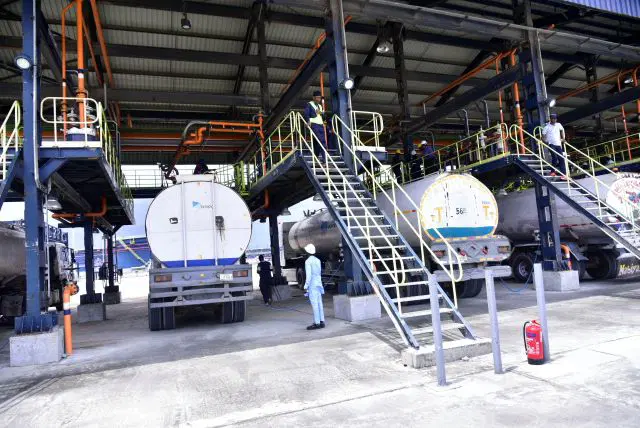
Nigeria’s largest refining facility has raised fresh concerns over crude oil supply shortfalls, warning that inconsistent deliveries are forcing it to source feedstock from international markets at higher costs, with implications for domestic fuel prices.
The Chief Executive Officer of the Dangote Refinery, David Bird, disclosed this during a recent Arise TV interview, monitored by ENigeria Newspaper, said the plant is receiving far less crude than required under its supply arrangement with the Nigerian National Petroleum Company Limited (NNPC), despite operating at full capacity.
According to him, the refinery needs between 13 and 15 cargoes monthly but is currently getting only about five, significantly limiting its ability to meet local fuel demand.
Bird noted that beyond the volume shortfall, inconsistencies in crude quality have also affected operations, forcing the refinery to turn to foreign markets. He described the situation as troubling, revealing that preferred Nigerian crude grades are often unavailable locally but reappear on the global market, where they are repurchased at premium prices.
“We have been very vocal that there is an existing arrangement in place under the Crude-for-Naira programme commonly misunderstood as a pricing regime, it is not. It is priced at full international benchmark crude oil pricing, however, without the foreign exchange implication.
“That has been very successful in stabilising the FX and I think Nigeria and our relationship with NNPC and Dangote, we should all be very proud of that. That agreement, however, is not only just from volume but also a quality allocation perspective not being met.
“And our demand of the government is just to be transparent with that allocation methodology because what we see under that agreement, we should be getting about 13 to 15 cargos a month and that’s what we could process to meet the domestic fuel requirements of Nigeria. Currently we’re only getting five.
“So that’s an underperformance against that pre-agreed volume contract. Second to that is quality. So Nigeria has a wide variety of crude grades all exported from different terminals and we have a preference,” he stressed.
He warned that this pattern is leading to value losses for Nigeria, as margins from such transactions benefit international traders rather than the domestic economy. The refinery, he added, now relies on imports for up to 40 per cent of its crude needs, exposing it to global price volatility, rising freight costs, and higher insurance premiums.
Despite assumptions to the contrary, Bird stressed that the Crude-for-Naira arrangement does not provide discounted crude, noting that purchases are made at full international benchmark prices, with additional logistics costs borne by the refinery. He said the policy has helped ease foreign exchange pressures but suffers from weak implementation, particularly around allocation transparency.
The refinery boss further explained that rising global energy costs, driven in part by geopolitical tensions, are feeding directly into production expenses, making it difficult to shield consumers from higher fuel prices. He maintained that while the facility aims to keep prices stable, it operates strictly on commercial terms without subsidy support.
Calling for reforms, Bird urged greater clarity and consistency in crude allocation, alongside broader efforts to address structural challenges in the oil sector. He emphasised that improving coordination across the value chain is critical for Nigeria to fully benefit from its refining capacity and reduce dependence on costly imports.