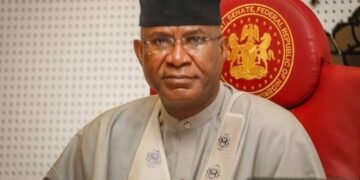

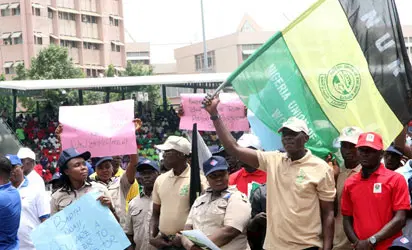
On May 1st, a day to commemmorate Workers’ Day, Joe Ajaero, the president of the Nigeria Labour Congress (NLC), bemoaned the high rate of poverty, hardship, inflation, and devaluation of the national currency, which he claimed had caused suffering and suffering for the populace.
As increased insecurity, worsening poverty, and ongoing inflation continue to undermine the value of labour and the dignity of work, Nigerian workers joined their global colleagues today to commemorate May Day under a cloud of dread, frustration, and economic hardship.
Dr. Toyin Olawunmi, a development expert with the TUC, said that Nigeria is approaching a perilous tipping point due to growing poverty and increased insecurity, endangering economic productivity, national stability, and the prospects for decent work.
“Nigeria cannot build decent work on frightened communities, hungry households, collapsing purchasing power, and weak public institutions”, he said.
He emphasized that millions of Nigerian workers are now fighting to survive under a variety of invisible pressures, including what he called “insecurity,” rather than just receiving salaries.
Olawunmi also added that insecurity was now a direct economic concern rather than just a military or police problem. He pointed out that the economy as a whole becomes unstable when traders are unable to transport goods safely, farmers are unable to access their land, and vital workers flee vulnerable places.
Reiterating his fellow colleague’s stance, President of the Nigeria Labour Congress, NLC, Joe Ajaero, bemoned the high rate of poverty, hardship, inflation, instability, and the devaluation of the national currency, which he claimed had caused suffering for the populace.
“Unless insecurity and poverty are urgently addressed, the nation will continue to struggle with rising unemployment and the collapse of decent jobs. About 90 per cent of jobs in Nigeria are in the informal sector, where workers lack security, pensions, and decent conditions”, he said.
“Decent jobs are gradually vanishing across industries, and this trend is worsening inequality and poverty. If insecurity is tackled, farmers will return to their farms, food production will improve, and jobs will expand.”
Acting General Secretary of the National Union of Electricity Employees, NUEE, Dominic Igwebike, on the Day, also commemmorated with workers on this day but highlighted several issues that have blighted the progress of dedicated and hardworking workers, especially electricity.
“Nigerian electricity workers”, he said, “are facing various economic challenges manifesting in arbitrary sackings, non-negotiation and implementation of conditions of service, salary stagnation, insecurity, unsafe work environments, casual and contract appointments, poor salaries, weak currency, and hyperinflation as we mark the 2026 May Day.
“In addition, we work under very unsafe environments and circumstances. Our linemen and technicians in the transmission sector are threatened daily by kidnappers and bandits, while distribution engineers and technicians are beaten daily by hoodlums and community youths. Our sales and marketing teams also face severe harassment, intimidation, and abuse while rendering services to the public”, he added.
Workers’ Day in Nigeria
ENigeria Newspaper notes that Workers’ Day is celebrated on May 1st across every states in Nigeria.